Morph
Hospital of St John and St Elizabeth  ·  Strategic Integration Brief  ·  Confidential  ·  April 2026

From admissionto recovery at home.

The case for embedding a Morph SaaS health layer across the full HJE patient journey, and the approximately 420 employees who deliver it.

£0Current structured post-discharge programme revenue per patient*
12,880Potentially eligible patients*
£900Potential six-month recovery revenue per patient£150/month × 6 months

Illustrative modelling based on public information and Morph research. Patient volumes and eligibility subject to HJE validation.

Scroll to explore ↓
The full health continuum

The journey most hospitals abandon at the door

UK private hospitals are world-class inside their walls. The moment a patient is discharged, the relationship, and the revenue, stops. Morph exists to own the phases before and after clinical care.

Pre-opPrehabilitation optimisation
AdmissionBaseline capture and onboarding
HJE todayIn-hospitalMonitoring and care
HJE todayDischargeMorph activation
Weeks 1 to 12Structured home recovery
Long-termPrevention and optimisation
Pre-opPrehabilitation optimisation
HJE todayIn-hospitalMonitoring and care
HJE todayDischargeMorph activation
AdmissionBaseline capture and onboarding
Weeks 1 to 12Structured home recovery
Long-termPrevention and optimisation
HJE earns revenue from stages 3 and 4 only. The four surrounding stages currently generate zero HJE income. Morph monetises all four.
The commercial gap

HJE has already earned the surgical fee. Everything that follows is worth nothing.

The surgical episode is complete, the fee is earned, and the patient leaves. What follows — weeks of recovery, rehabilitation, medication adherence, and clinical check-ins — is managed ad-hoc by GPs with no HJE involvement and no HJE income. This is not a clinical gap. It is a revenue gap on patients HJE already has.

The reason post-discharge recovery is currently unsupported at scale is not a lack of clinical intent. It is a resource constraint that no amount of hiring resolves at acceptable cost. Hospital physiotherapists are doing exactly what they should be doing — delivering high-dependency inpatient care. They cannot simultaneously conduct daily remote follow-ups with every discharged patient. Without structured support, clinical evidence shows 60 to 70% of patients do not adhere to home rehabilitation programmes. Morph extends the physiotherapy team's reach beyond the hospital walls — without adding headcount, without changing clinical accountability, and without disrupting ward operations.

£0

Post-discharge revenue per patient at HJE today

0

Eligible patients per year already in the HJE system

0%

Unplanned readmission rate in UK private hospitals

£40M

Revenue gap to HJE's five-year £100M target

Source: Public information and Morph research. Subject to validation with HJE.

New commercial opportunity and workforce performance value

One platform. Two dimensions of value.

Morph operates on two parallel tracks at HJE simultaneously. Track 1 monetises the post-surgical phase for patients who have already had their operation — net-new revenue that does not touch the surgical pipeline. Track 2 delivers workforce performance value rather than new revenue, improving retention and reducing absenteeism across a workforce of approximately 420 employees and protecting the operational capacity that delivers surgical throughput. Extending value beyond discharge. Strengthening performance from within.

Track 1: Revenue growth beyond discharge

  • New paid recovery and telehealth pathways
  • 12,880 eligible surgical and post-natal patients per year
  • 6-month programme at £900 per patient
  • £2.3M to £4.6M illustrative gross programme revenue opportunity at 20 to 40% uptake
  • £575 remaining contribution per patient before other direct programme costs and commercial profit share, based on working practitioner delivery assumptions
  • Outcomes reportable to insurers, consultants, and HJE board

Conservative model: inpatient admissions plus 25% of paediatric volume only

Source: Public information and Morph research. Subject to validation with HJE.

Track 2: Performance uplift across HJE

  • Healthier, more engaged, higher-performing teams
  • Approximately 420 HJE staff: nurses, theatre teams, admin, support
  • Structured preventative health pathways for the workforce
  • Reduces absenteeism, presenteeism, and staff burnout
  • Internal proof-of-concept before patient rollout begins
  • Morph embedded in HJE culture from day one

Internal adoption creates operational credibility across the hospital

The Health League: gamification for HJE staff

Turn employee health into a game the whole hospital can play.

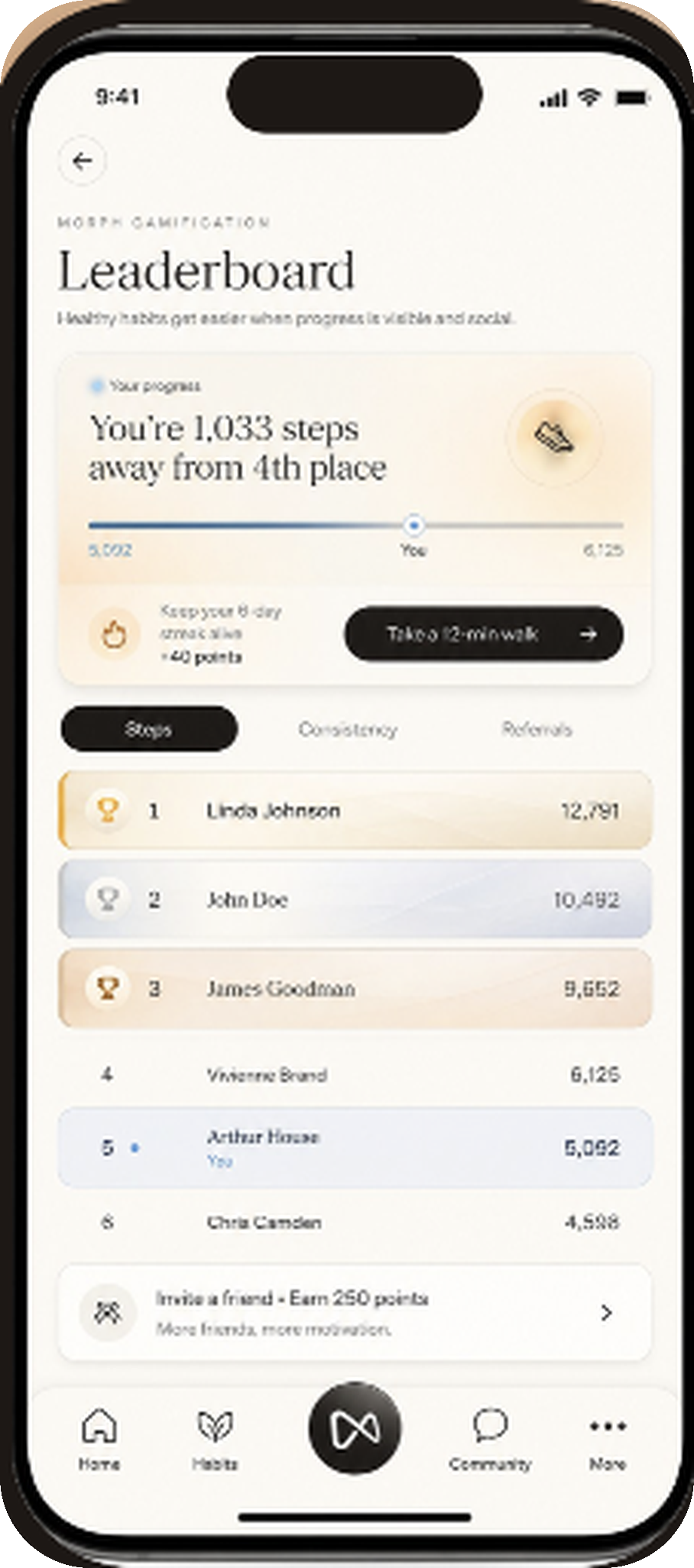
Every step, check-in, and session completed by an HJE employee becomes points. Points build a weekly score, a rank, and a live leaderboard the whole hospital can see in the app. Built on consistency, not who is fittest. Everyone starts on level ground, with real vouchers and prizes for the leaders.

Nurses, theatre staff, admin teams, and support workers all compete on the same leaderboard: steps, Habit Hacker check-ins, wellness programme completions, and practitioner sessions all feeding one score. Engagement is visible. Progress is social. Retention improves.

StepsHabit HackerWellness programmePractitioner sessionsLive leaderboard
Option One

Plug into what you already have

Morph layers on top of HJE's existing health benefits, turning them into points, progress, and a league your people actually check every day.

Option Two

Run the full programme

Bloodwork, coaching, and the complete Morph programme, all feeding the same hospital-wide Health League from day one.

Morph Health League leaderboard on a mobile phone
Post-surgical recovery pathways

Four post-surgical programmes. Revenue begins at the point of discharge.

Four structured recovery programmes, each deployed after the clinical episode is complete. Each pathway runs 12 weeks and generates approximately 254 patient touchpoints: 24 live practitioner sessions and 230 digital interactions.

These are not prevention programmes. They are post-operative and post-natal recovery protocols that begin the moment HJE's surgical role ends — converting that transition point from a revenue cliff into a recurring income stream.

1. Post-orthopaedic recovery

Objective: Accelerate safe return to function; reduce pain, swelling, and complications.

Digital layer: Wearables (steps, sleep, HRV), biometric face-scan as pain/stress proxy, ROM uploads, wound photos, pain scale.

WeeksFocusMilestones
Weeks 0 to 2Protect and activateWound and DVT monitoring, gentle activation
Weeks 3 to 6Strength and rangeROM progression, swelling control, gait retraining
Weeks 7 to 12FunctionBalance, load tolerance, return to ADL
Pain VAS 30 to 50%ROM 80%+ADL within 12 wksAdherence 65%+NPS 75+

2. Post-cardiac surgery

Objective: Restore functional capacity, stabilise cardiac function, weight management, reduce readmission risk, and improve lipid profiles.

Digital layer: Continuous remote monitoring via wearables, face-scan biometrics (HRV and BP), medication logs. Every heartbeat a predictive safety signal.

WeeksFocusMilestones
Weeks 0 to 2StabiliseWound care, gentle breathing, medication adherence
Weeks 3 to 6RebuildProgressive walking, light resistance, sleep normalisation
Weeks 7 to 12OptimiseFunctional cardio, stress control, return-to-work plan
Adherence 65%+Readmission reduced 25%NPS 75+

3. Post-natal recovery

Objective: Support safe, confident post-partum recovery across pelvic health, strength, sleep, and mood.

Digital layer: Wearables: resting HR, skin temperature, sleep tracking. Face-scan biometrics (BP, sympathetic vs para-sympathetic). A data-guided journey for mother and baby.

WeeksFocusMilestones
Weeks 0 to 2StabiliseWound/perineal care, gentle activation, pelvic health fundamentals
Weeks 3 to 6RebuildPelvic floor progression, posture, light strength, fatigue and sleep care
Weeks 7 to 12OptimiseFunctional strength, mood support, return to ADL and work plan
Pain reduced 40%+PND screened 90%+ADL 12 wksAdherence 65%+NPS 75+

* Weekly cognitive therapist check-in recommended for new mothers

4. Pre- and post-diabetes management

Objective: Reduce glycaemic volatility, improve metabolic resilience, and sustain long-term adherence.

Digital layer: Optional CGM integration. Wearables (HRV, steps, sleep), face-scan, stress index, nutrition and medication logs. GLP-1 support (Semaglutide).

WeeksFocusMilestones
Weeks 0 to 2BaselineGlucose mapping, movement screen
Weeks 3 to 6InterventionDiet re-patterning, stress control, activity protocol, GLP-1 monitoring
Weeks 7 to 12ConsolidateResistance training, habit anchoring, relapse planning
HbA1c reduced 0.5 to 1.0%Weight reduced 3 to 5%Adherence 65%+NPS 75+

Source: Public information and Morph research. Subject to validation with HJE.

The physiotherapy reach gap

HJE, powered by Morph, turns discharge into the beginning of a new recovery relationship and a scalable new revenue stream.

Recovery is more than rehabilitation. Physical recovery, pain and function, confidence, cognitive and emotional wellbeing, sleep, nutrition, adherence and changing recovery needs can all influence what happens next.

Powered by Morph, HJE can bring these elements together in one structured recovery pathway, combining daily digital support, biometric and patient-reported monitoring, personalised recovery activity, education and focused practitioner support.

HJE retains the patient relationship and clinical oversight. Morph provides the infrastructure and recovery support that allows structured care to extend beyond the hospital without requiring HJE clinicians to deliver every interaction.

The commercial opportunity is equally important. Instead of the structured patient relationship reducing sharply at discharge, HJE can extend it through a six-month supported recovery programme, creating greater continuity, deeper engagement, more meaningful patient touchpoints and the opportunity to build patient lifetime value beyond the surgical episode.

Orthopaedics and musculoskeletal

Hip, knee, spinal, and fracture patients leave with a printed exercise sheet and good intentions. Morph ensures those exercises are actually done — daily, tracked, and reportable to the consultant at the six-week follow-up.

Cardiac recovery

Post-intervention patients need daily medication adherence, HRV monitoring, and progressive activity. A phone call once a week from a busy physio cannot deliver this. Morph does it continuously, flagging clinical concerns before they become readmissions.

Post-natal rehabilitation

New mothers are discharged with pelvic floor guidance and an expectation of self-management. Morph provides daily support, mood screening, and structured progression — the follow-up care the physio cannot provide remotely at this frequency.

Metabolic and diabetes management

Behavioural change at home fails without daily accountability. Morph provides the nudges, nutritional logging, and adherence tracking that a clinic visit once every six weeks cannot sustain.

Physio expertise stays on the ward — Morph extends it beyond the buildingEvery discharged patient becomes a 12-week revenue relationship, not a closed episode60 to 70% of patients without structured support do not adhere to home rehabilitation

Source: Public information and Morph research. Subject to validation with HJE.

Revenue model

Conservative floor. No surgical growth assumed.

Commercial model assumptions
  • £150per month
  • 6 monthsprogramme duration
  • £25/hourworking practitioner assumption
  • 2 × 15 minspractitioner sessions per week
HJE scale assumptions
  • 2,576patients
  • 20%uptake
  • £2.32Millustrative gross programme revenue opportunity

Patient pool: 7,200 inpatient admissions plus 5,680 age-eligible paediatric operations (25% of 23,000 annual total) = 12,880 eligible patients per year. Urgent care attendances excluded. No insurer referrals included. No assumed growth in surgical volume.

Illustrative scenario based on publicly available information and Morph research. Patient volumes and eligibility assumptions subject to validation with HJE.

ScenarioPatients per yearProgramme feeAnnual gross programme revenue opportunityRemaining contribution / patient*
Conservative 20%2,576£900£2.32 million£575
Base case 30%3,864£900£3.5 million£575
Optimistic 40%5,152£900£0.0 million£575

*Working commercial assumption: 2 × 15-minute practitioner sessions per week for approximately 26 weeks at £25/hour = £325 practitioner delivery cost per patient. £575 is remaining contribution before other direct programme costs and commercial profit share, not profit.

Implementation cost subject to scoping
Zero new clinical headcount
Zero new beds required
£2.32M · 20%
£2.32 million
£3.5M · 30%
£3.5 million
£4.6M · 40%
£4.6 million
The £900 recovery engine

Digital frequency. Human expertise. Continuous recovery.

Morph extends structured support beyond discharge, combining high-frequency digital engagement with focused practitioner intervention.

£150per month
×
6months
=
£900six-month gross programme revenue per patient

Continuous digital recovery, reinforced by human expertise.

Every day

Morph digital recovery

Biometric check-in
Habit Hacker
Recovery programme
Education
Activity + wearables
Adherence
Progress
Recovery signals

Technology creates continuity.

Twice weekly · working delivery scenario

Human practitioner contact

2 × 15minute remote touchpoints per week
30 minuteshuman support per week

Practitioners provide expertise, support and appropriate escalation. HJE retains clinical governance.

Per patient · working economics

Supported recovery at scale

Gross programme revenue£900
Working practitioner delivery cost− £325
Remaining programme contribution£575

Before other direct programme costs and commercial profit share.

One patient becomes a hospital-scale opportunity
One patient£900gross programme revenue
20% uptake scenario2,576patients, subject to HJE validation
Gross opportunity£2.32Mgross programme revenue opportunity
Working delivery£837Kpractitioner delivery cost
Remaining contribution£1.48Mbefore other direct costs and agreed commercial profit share
Subject to final commercial agreement
Other agreed direct programme costsDistributable programme economicsMorph ↔ HJE
agreed commercial profit share

Cost definitions, implementation treatment and profit-share terms remain to be agreed.

Illustrative scenario based on publicly available information and Morph research. Patient volumes and eligibility assumptions subject to validation with HJE. Practitioner time (2 × 15 minutes weekly over approximately 26 weeks) and £25/hour are working commercial assumptions: 13 hours × £25 = £325 per patient; £325 × 2,576 = £837,200; £900 × 2,576 = £2,318,400; remaining contribution = £1,481,200 before other direct programme costs. Working assumptions remain subject to final operating, technical and commercial agreement.

The revenue stack: four streams, not one

The table above is one stream at conservative uptake. Three more sit on top of it.

The full commercial architecture layers three additional revenue streams on top of patient self-pay — each one independent, each one compounding the value of HJE's existing patient base without requiring a single additional surgical procedure.

1

Post-discharge self-pay

£900 per patient. 12,880 eligible per year. £2.3M to £4.6M at 20 to 40% uptake. The core revenue stream — active from day one.

2

Insurer-funded programmes

When AXA, Bupa, or Vitality fund the programme directly, the patient pays nothing. Conversion moves from 20 to 40% to 60 to 80%. Same £900 per patient — materially higher volume.

3

Prehabilitation

Structured pre-operative conditioning in the 4 to 6 weeks before surgery. Proven to improve surgical outcomes. £300 to £500 per patient on 7,200 annual admissions — £2.1M to £3.6M additional revenue, entirely untapped today.

4

International patients

HJE's international patients fly home 2 weeks post-surgery. Morph makes geography irrelevant. The same 12-week programme, same biometric monitoring, billed by HJE. Zero marginal infrastructure cost.

Stream 1 is available from day one. Streams 2 and 3 activate within 6 to 12 months. Stream 4 requires no additional infrastructure — only a patient with a smartphone and a Morph programme.

Source: Public information and Morph research. Subject to validation with HJE.
Clinical governance and escalation

How does Morph safely extend HJE care into the home?

Through a clearly governed partnership. HJE retains clinical oversight, while Morph provides the monitoring, engagement and escalation layer that extends structured support beyond discharge.

Daily monitoring

Morph clinical team reviews biometric and behavioural data across all active patients every 24 hours.

4-hour flag

Any threshold breach — HRV anomaly, pain spike, missed medication, or non-engagement pattern — is flagged to the Morph clinical lead within 4 hours.

HJE escalation

Clinical concern is escalated to the named HJE clinical contact — the responsible consultant or ward lead — with a full data summary. HJE makes the clinical decision.

Full accountability

HJE retains complete clinical accountability throughout. Morph does not diagnose, prescribe, or make clinical decisions independently.

Morph also generates the first longitudinal recovery dataset HJE has ever had. Continuous biometric and behavioural data from discharge to 12 weeks strengthens PROMS reporting, supports clinical outcomes publications, and provides consultant revalidation evidence — a research asset no claims dataset can replicate.

Why this works commercially for HJE

None of the opportunities below require HJE to see fewer patients, perform fewer procedures, or earn less from its surgical core. Every one adds to what the hospital already earns. Where appropriate, additional commercial activity can also support HJE's wider charitable mission and St John's Hospice.

Beyond revenue

Net-new revenue stream

£900 per patient on a population already inside the HJE system. Zero cannibalisation of the surgical pipeline. Every pound is income HJE currently leaves on the table at the point of discharge.

Unplanned readmission protection

Unplanned readmissions consume elective capacity, trigger CQC reporting, and damage clinical reputation. Structured remote rehabilitation reduces the complication rate that drives them — before the patient returns through urgent care.

Optimised bed utilisation

A patient with a clear, supported recovery pathway is clinically ready to discharge sooner. That bed is available for the next elective admission — increasing surgical throughput, not reducing it.

Consultant outcomes and caseload growth

When patients adhere to their rehabilitation, the six-week follow-up reflects the quality of the surgery — not six weeks of inactivity. Consultants whose outcomes are demonstrably strong become more referable. More referrals mean more cases at HJE.

NPS, referrals, and repeat attendance

A patient who recovers well under the HJE brand refers family and friends for their elective procedures. NPS above 75 in a word-of-mouth private healthcare market is a durable commercial asset.

First-mover position in London private

No London private hospital currently offers structured, branded digital post-discharge recovery at scale. HJE has the volume, the credibility, and the clinical depth to own this category now.

90-day pilot: what success looks like

Three metrics. Clear thresholds. No ambiguity.

The pilot ask is 150 patients, 90 days, zero capital expenditure. Three metrics define whether Morph proceeds to full deployment. If all three are met, the case for scale is self-evident. If they are not, there is no further obligation.

Adherence rate55%+

Industry norm for digital rehab is 30 to 40%. Morph targets 65%+. 55% at 90 days confirms the model is working and trajectory is right.

Patient NPS65+

A score above 60 is considered excellent. 65+ at 90 days establishes a referral-grade patient experience under the HJE brand.

Revenue run-rateOn track for £2.3M

90-day enrolment and programme completion data must show annualised trajectory consistent with the conservative 20% uptake scenario.

The procedure ends. The relationship continues. Morph extends HJE's recovery capability beyond the hospital, giving every patient structured support throughout recovery. Better continuity. Better engagement. Better outcomes. And a longer patient relationship that creates new lifetime value and a new revenue opportunity for HJE. 

MORPH Health Optimisation Platform  ·  morph.fit  ·  +44 7879 236 205